
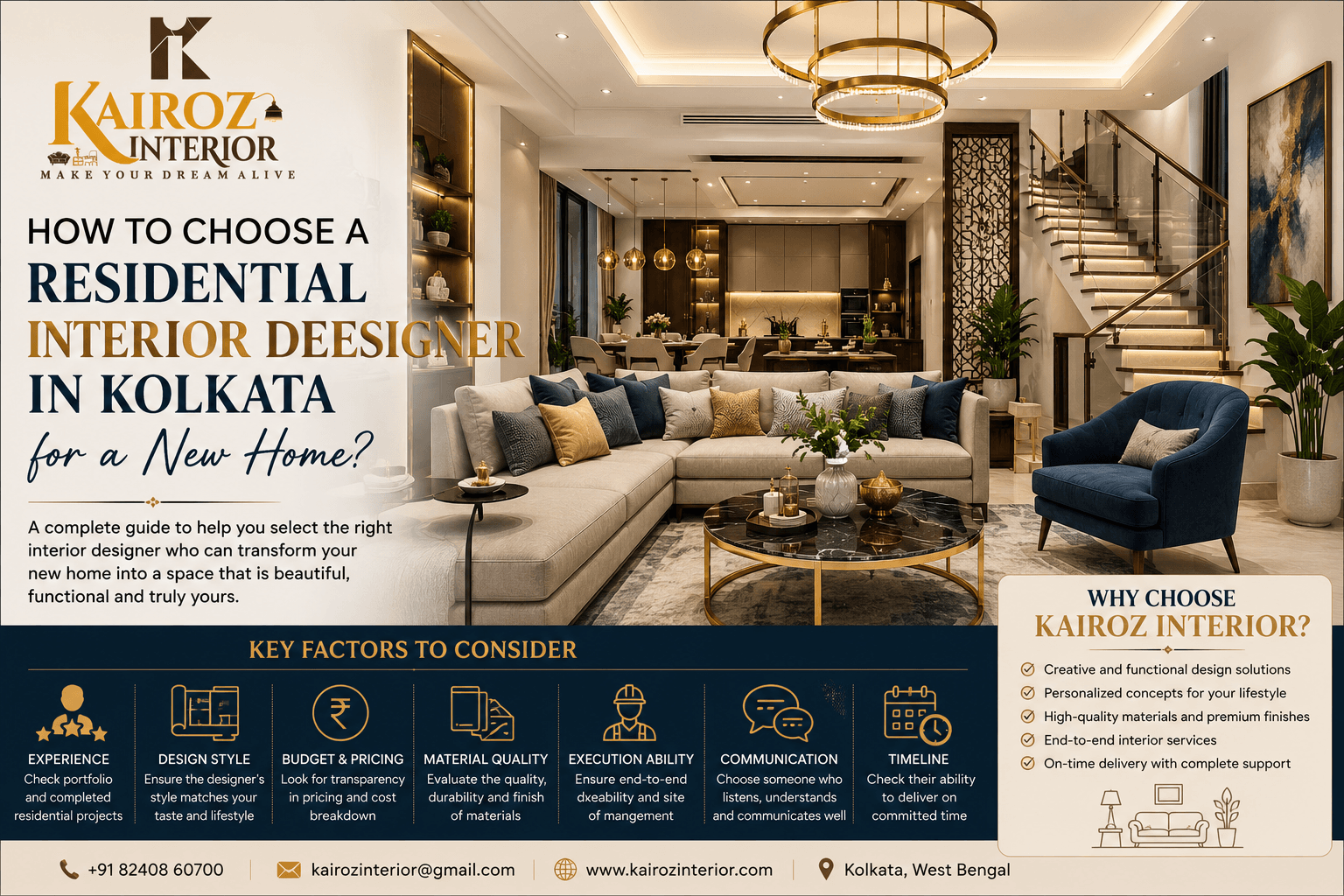
Designing a new home is an exciting investment, but turning an empty property into a comfortable and functional living space requires more than choosing attractive furniture and colours. A professional Residential Interior Designer in Kolkata can help homeowners plan the layout, select materials, design storage, coordinate lighting and create a cohesive interior based on their lifestyle.
However, choosing the right designer can be challenging. Kolkata has a wide range of interior designers, decorators, contractors and turnkey interior companies offering different services, design styles and pricing models. The right choice depends not only on a designer’s portfolio but also on their ability to understand your requirements, manage the project and deliver practical solutions within an agreed budget.
Whether you are designing a flat, independent house or villa, knowing what to evaluate before hiring an Interior Designer in Kolkata can help you make a more informed decision.
What Should You Look for in a Residential Interior Designer in Kolkata?
The best designer for your home should combine creativity with practical planning, technical understanding and project management.
Before making a decision, consider these important factors:
- Relevant residential project experience
- Portfolio and design style
- Understanding of space planning
- Material and product knowledge
- Budget transparency
- Project execution capabilities
- Communication and coordination
- Customisation options
- Timeline management
- After-sales or post-installation support
A designer who creates visually impressive interiors may not necessarily be the right fit if their approach does not match your lifestyle or budget.
1. Check the Designer’s Residential Experience
One of the first things to evaluate is whether the designer has experience with projects similar to yours.
For example, designing a compact apartment requires different planning strategies from designing a large villa. Similarly, a 2BHK, 3BHK or luxury residence may have different storage, furniture and space-planning requirements.
Ask to see examples of completed residential projects rather than relying only on concept images or mood boards.
Look for experience with:
- Living room interiors
- Master bedrooms
- Children’s bedrooms
- Modular kitchens
- Wardrobes and storage
- Dining areas
- Home offices
- Pooja rooms
- Foyers
- Bathrooms
- Balconies and utility areas
Relevant experience indicates that the designer understands the practical challenges associated with residential projects.
2. Review the Interior Design Portfolio Carefully
A portfolio can tell you a lot about a designer’s capabilities, but it should be evaluated beyond aesthetics.
Look for consistency in:
- Space planning
- Furniture proportions
- Lighting
- Colour combinations
- Storage solutions
- Material selection
- Functional layouts
- Finishing quality
Do not choose a designer simply because one project looks attractive. Instead, determine whether the designer can adapt their style to different homeowners.
A good Modern Home Interior Designer Kolkata homeowners choose should be able to create contemporary spaces while adapting the design to the property’s architecture and the client’s preferences.
3. Make Sure the Designer Understands Your Lifestyle
Your home should be designed around how you live, not simply around current interior trends.
Before finalising a designer, discuss your daily routine and expectations.
For example:
- Do you work from home?
- Do you frequently entertain guests?
- How much storage do you need?
- Do you cook regularly?
- Do you have children or elderly family members?
- Do you need a dedicated study?
- Do you collect books, artwork or other items?
- Do you prefer minimalist or decorative interiors?
A good designer should ask these questions before proposing a design.
This lifestyle-first approach can result in a home that remains comfortable and practical long after the project is completed.
4. Discuss Your Budget at the Beginning
Budget is one of the most important factors in residential interior design.
Before work begins, establish a realistic budget that considers the complete scope of the project.
Depending on the project, expenses may include:
- Civil modifications
- Electrical work
- False ceiling
- Flooring
- Painting
- Modular kitchen
- Wardrobes
- Furniture
- Lighting
- Curtains and blinds
- Decorative elements
- Appliances
- Installation
- Design and project management fees
Ask the designer what is included and excluded from the quotation.
A clear cost structure can help prevent unexpected expenses during execution.
5. Ask About Materials and Finishes
Material selection has a major impact on the appearance, durability and maintenance requirements of a home.
Discuss the options available for:
- Kitchen cabinets
- Wardrobes
- Countertops
- Flooring
- Wall finishes
- Hardware
- Glass
- Wood finishes
- Upholstery
- Lighting fixtures
The cheapest material is not always the most economical choice in the long term. Similarly, the most expensive material may not always be necessary.
An experienced designer should explain the advantages, limitations, maintenance requirements and approximate lifespan of different options.
6. Evaluate Space Planning Skills
Good interior design starts with effective space planning.
A designer should understand how people move through the home and how each room will be used.
For example, a living room should provide comfortable circulation between seating, television units, balconies and other spaces. A bedroom should provide sufficient clearance around the bed and convenient access to wardrobes.
In kitchens, work zones and appliance placement need careful planning.
For homeowners considering a U Shape Modular Kitchen Kolkata, the designer should assess available wall space, work-flow requirements, storage needs and appliance positions before recommending a layout.
7. Ask Whether the Company Provides Design and Execution
Some designers focus mainly on design, while others provide complete interior execution.
Understanding the scope is essential.
A turnkey interior service may coordinate several components, including:
- Design development
- Drawings
- Material procurement
- Carpentry
- Modular furniture
- Electrical work
- Painting
- False ceiling
- Kitchen installation
- Wardrobe installation
- Project supervision
If you want a single team to coordinate the project, ask whether the company provides end-to-end execution.
8. Compare More Than Just the Quotation
Getting multiple quotations can be useful, but comparing only the final price can lead to poor decisions.
Two companies may quote different amounts because they are offering different materials, hardware, furniture specifications or levels of project management.
Instead, compare:
Design scope + Materials + Workmanship + Timeline + Warranty/Support + Project Management + Price
This gives you a more meaningful understanding of the value being offered.
A slightly higher quotation may be justified if it includes better materials, experienced supervision and a more comprehensive scope.
9. Understand the Project Timeline
A new-home interior project involves multiple stages, and delays in one area can affect the entire schedule.
Ask your prospective designer about:
- Design finalisation
- Material selection
- Procurement
- Manufacturing
- Site preparation
- Installation
- Electrical work
- Painting
- Final finishing
- Handover
The designer should provide a realistic timeline rather than promising an unusually short completion period without considering the project’s scope.
10. Evaluate Communication and Project Management
Communication can significantly influence the overall interior design experience.
Before hiring a designer, understand:
- Who will be your primary contact?
- How frequently will updates be provided?
- Who supervises the site?
- How are design changes handled?
- How are delays communicated?
- Who coordinates vendors and contractors?
- How are approvals documented?
Clear communication helps minimise misunderstandings between homeowners, designers and execution teams.
11. Look for Customisation Instead of Ready-Made Solutions
Every home has a different layout and every family has different requirements.
A good residential designer should be able to customise solutions around the available space.
Customisation may include:
- Built-in storage
- Personalised wardrobes
- Custom TV units
- Modular kitchen layouts
- Home-office furniture
- Children’s study areas
- Multipurpose furniture
- Decorative walls
- Custom lighting plans
The objective should be to make the available space work better rather than simply filling it with furniture.
12. Check Reviews, References and Completed Projects
Online reviews can provide useful information, but homeowners should consider multiple sources before making a decision.
If possible, ask the designer for references or examples of completed projects.
Questions you can consider include:
- Was the project completed on time?
- Was the quoted budget maintained?
- How was communication?
- Was the workmanship satisfactory?
- How were changes handled?
- Was post-installation support available?
Actual project experience can provide insights that a portfolio alone cannot show.
13. Choose a Designer Who Understands Kolkata Homes
Local knowledge can be valuable when designing residential interiors in Kolkata.
A designer familiar with the city may understand common apartment layouts, local construction practices, available materials, vendor networks and climate-related considerations.
For example, ventilation, moisture management, material selection and maintenance requirements can influence interior decisions.
For homeowners searching for Best Interior Designer in Kolkata, local experience should therefore be considered alongside portfolio quality and design expertise.
14. Ask the Right Questions Before Hiring
Before signing an agreement, ask the designer specific questions.
Important questions include:
- How many residential projects have you completed?
- Do you provide complete execution or design-only services?
- What materials and brands do you typically use?
- What is included in the quotation?
- Are design changes included?
- Who supervises the project?
- What is the expected completion timeline?
- How are additional costs handled?
- What type of post-installation support is provided?
- Can you show examples of completed projects similar to mine?
Clear answers can help you compare different service providers more effectively.
What Makes a Good Residential Interior Designer?
A good residential interior designer should be able to connect design, functionality, budget and execution.
Creativity is important, but it is only one part of the process. The designer should also understand materials, dimensions, storage, lighting, furniture proportions and practical construction requirements.
The ideal professional listens to the homeowner, explains options clearly and develops a design that fits the property’s architecture and the family’s lifestyle.
Companies such as Kairoz Interior can approach residential projects by combining design planning with practical requirements, helping homeowners develop interiors that are visually appealing while remaining functional for everyday use.
How Can You Make the Final Decision?
After evaluating several designers, create a simple comparison based on the factors that matter most to your project.
Consider:
| Factor | What to Evaluate |
|---|---|
| Experience | Similar residential projects completed |
| Portfolio | Quality, variety and design consistency |
| Design | Ability to understand your preferences |
| Materials | Quality, durability and specifications |
| Budget | Transparent and detailed quotation |
| Execution | In-house or coordinated execution |
| Timeline | Realistic project schedule |
| Communication | Regular updates and clear coordination |
| Customisation | Solutions tailored to your home |
| Support | Installation and post-project assistance |
This approach helps you make a decision based on overall value rather than selecting a designer solely because of price.
Conclusion
Choosing the right Residential Interior Designer in Kolkata is an important decision because the designer can influence how your home looks, functions and feels for many years.
Start by reviewing relevant residential experience and completed projects. Then discuss your lifestyle, design preferences, budget, materials, storage requirements and project timeline. Make sure you understand exactly what is included in the service and how the execution process will be managed.
The best designer is not necessarily the one offering the lowest quotation or the most luxurious-looking portfolio. It is the professional who can understand your requirements, plan the space efficiently, communicate clearly and deliver a practical design within your expectations.
For homeowners planning a new flat, independent house or villa, working with an experienced Interior Designer and Decorator in Kolkata can make the journey from an empty property to a personalised home much more organised.
With the right planning, materials and execution strategy, your new home can combine aesthetics, comfort, storage and functionality while reflecting your family’s individual personality. Kairoz Interior can be considered as part of the selection process when evaluating residential interior design solutions in Kolkata.
Frequently Asked Questions
Look for relevant residential experience, a strong portfolio, transparent pricing, material knowledge, project management capabilities, communication skills and the ability to customise designs according to your lifestyle.
Residential interior design costs vary depending on the home’s size, design complexity, materials, furniture, modular kitchen, wardrobes, civil work and execution requirements. A detailed quotation should be obtained after assessing the project.
An interior designer focuses primarily on design, planning and aesthetics, while an interior contractor focuses more on execution. Some companies provide both services, which can simplify project coordination.
Ideally, engage an interior designer before major interior work begins. Early planning allows electrical points, lighting, storage, kitchen layouts and other requirements to be incorporated into the design.
Yes. A designer can incorporate selected existing furniture into the new design where its size, condition and style are suitable. This can also help control the overall project budget.
The timeline depends on the property’s size, design scope, material availability and execution requirements. A detailed project schedule should be discussed before work begins.
It can be included depending on the service package. Homeowners should confirm whether the quotation covers kitchen cabinets, hardware, countertops, appliances, lighting and installation.
Compare quotations based on the complete scope, material specifications, hardware, workmanship, project management, timeline and support rather than comparing only the final price.
Space planning ensures that furniture, storage, lighting and circulation work together efficiently. It helps prevent wasted space and improves everyday usability.
Yes. Luxury can be created through thoughtful space planning, selective premium materials, customised details, lighting and quality finishes. A designer can prioritise investments according to your budget.
A local designer may have better familiarity with local suppliers, construction practices, apartment layouts, materials and project execution requirements, which can support smoother project coordination.
